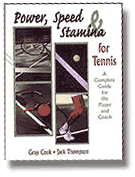
Power, Speed & Stamina
for Tennis
| All prices include shipping & handling (U.S. orders only). For international orders, call 800-400-7542 |
Power, Speed & Stamina for Tennis
Price: $20.95
 |

 |
Back to
Books/Education
page |
About the Book:
"...Extensively researched, this book builds a compelling blueprint as to how to optimally train tennis players. Explodes a number of myths about how to train. Get it and read it today."
— Robbie Smith
Originator of the USPTA Professional Test
Author: Thinking Tennis
Founder: Robbie Smith Tennis Academy
Coach of more than 70 world ranked players
Formerly ranked #1 in U.S. by USPTA
"...The advanced juniors that I'm working with enjoy the exercises immensely. My training has taken on a new dimension since using the program myself. Highly recommended!"
— Tim Wilkison
Nuveen Tour Champion
ATP Tour Professional
Director of Tennis, Quail Hollow Country Club
Charlotte, NC
"...Having worked with the program, I've seen impressive and rapid developmental results in competitive junior players. We have in fact, adopted the program for all of our USTA/Mid Atlantic Training Centers!"
— Janine Underwood
USTA /MAS Director of Competitive Training/Player Development
"...An excellent book to improve performance and help prevent injuries...safe and effective exercises for all aspects of tennis performance...a must read book for competitive tennis players and coaches at all levels."
— Dr. Jeff Chandler
Exercise Physiologist, Lexington, Kentucky, Nationally recognized lecturer and author on tennis conditioning
Senior Editor, National Strength and Conditioning Journal
by Gray Cook & Jack Thompson
The most thorough, innovative and heavily
researched text to date for Tennis-Specific
Conditioning. Learn how to work smarter,
not harder!
What's Inside:
Sport-Specific Training Through the Ages:
What the Experts Have to Say
Rationale for the Use of Sport-Specific
Conditioning for Tennis
• P.N.F. Exercise
• Plyometric Exercise
• The role of interval training in tennis
performance
• The role of arm and grip strength in
tennis performance
• The role of hip and leg strength in
tennis performance
• The role of trunk strength in
tennis performance
• The role of weight transfer in
tennis performance
Common Errors Observed by Coaches
• Common Quotations from the Coach
Sport-Specific Testing for Tennis
• The Medicine Ball Lift Throw
• The Medicine Ball Chop Throw
• The Acceleration/Deceleration Shuttle Run
• The Box Agility Run
• The Standing Long Jump
• Grip Strength Dynamometry
• The Service Speed Test
Forward
by Dr. Jeff Chandler
It was not too many years ago that the statement "tennis players do not need to train with weights" was the popular notion. That is certainly no longer the case, thanks to work by people like Jack Thompson and Gray Cook. Resistance training for tennis players is an important part of the overall program for all types of players. Also, we are beginning to realize that there is more to resistance training than lifting weights. This book is full of new ideas and fun and competitive ways to train for tennis.
We now realize that the training program for tennis players is more than just resistance training or long distance running. Tennis players are required to move quickly to the ball, balance themselves for the appropriate shot, produce a powerful stroke into the opponents court, and then recover quickly to the center of the court while preparing themselves to retrieve the next shot. Tennis players are athletes. By training their skills as an athlete, we will make them better athletes, and better tennis players.
"Power, Speed, and Stamina for Tennis" is the ultimate book in describing the integration of science and performance in tennis play. It is the only book, to my knowledge that integrates the concept of PNF exercises to tennis. Tennis is a game played in multiple planes of motion. By realizing this, and by developing conditioning programs that recognize this, we are presented with a very unique and complete program for tennis conditioning.
Plyometric exercises have been performed in training for some sports for many years. But the value of plyometric exercises in tennis has not yet reached its full potential. Tennis is a ballistic sport, and plyometric exercises train this ballistic aspect of tennis. With the appropriate use of plyometric training as outlined by Jack Thompson and Gray Cook, we can maximize performance in tennis athletes. Plyometric training is a must for tennis players whose goal is to maximize performance.
It was also not too many years ago that tennis players trained using long distance running. Even a very superficial evaluation of the sport of tennis indicates this is not the way tennis is played. If training is to improve performance, the training must be metabolically specific to the sport. Tennis is a sport that requires a work-to-rest ratio of approximately 1:3. Many of the major professional matches now have a much lower work-to-rest ratio. Most all of the exercises in this book can be performed using a variety of work-to-rest ratios, depending on the fitness levels of the participants, and the specific goals of the group. For general fitness, recreational tennis players may want to increase the time spent playing tennis compared to the time spent working. This would serve to maximize their time spent on the tennis court in terms of improving fitness. Competitive players may want to train at a variety of work-to-rest intervals, including some very short but highly intense work bouts. The book includes a clear explanation of why tennis is primarily anaerobic in nature, and why training for tennis needs to fall into this category.
The role of sport-specific testing is stressed, and innovative methods of testing the sport-specific characteristics of tennis are described. Testing with sport-specific medicine ball throws is a logical and valuable addition to any testing program for tennis players, whether they are professionals, elite juniors, or beginning adults. A regular testing program can be crucial in motivating tennis athletes to improve their fitness. Young people are by nature competitive. You may be able to use this competitiveness to motivate players to improve their fitness levels. If you are working with a group that is not competitive, encourage them to compete against their own scores.
As with any good conditioning plan, this program begins with the development of strength and flexibility. And where many exercise programs end, in this program, the training has just begun.
The concept of weight transfer in teaching tennis strokes is not new. In this book, you will learn how to teach weight transfer using conditioning exercises as well. Smooth transfer of weight is crucial to performing almost every tennis stroke, and perhaps more importantly, to perform the strokes over and over again with power, control, and velocity.
In summary, if you are looking for an innovative, motivational, and effective conditioning program with a solid scientific base, then this program is for you. As you read the book, look for ways to integrate the different parts of the program into what you are already doing. The equipment needs are minimal and should not limit the implementation of the program. Time requirements, once the program is learned, are minimal. In fact, because the program is both time efficient and effective, time spent on conditioning may actually decrease over the long term.
This book is, as it states in the title, a complete guide. It is for both the player and the coach. I encourage you to use the program in its entirety. A warrior without a complete set of armor exposes his weakness to the opposition. A tennis player without a complete conditioning program does the same. This book clearly outlines the major areas of focus for success in conditioning for tennis. I encourage you to put on all of the armor. Begin with a sport-specific testing program, develop a strong and flexible muscular base, and progress to a conditioning program that utilizes the concepts of plyometrics, PNF, weight transfer, sport specific strength, and metabolically specific cardiorespiratory fitness. Although we cannot turn every player into a highly ranked professional, we can help players reach the highest level of performance within their ability level.
— Dr. Jeff Chandler
Editor-in-Chief,
Strength & Conditioning
Director of Research & Education
Lexington Sports Medical Center
Lexington, Kentucky